Tuesday, July 26, 2016

Evening Shopping in Kathmandu Tuesday, July 26, 2016 at 5 PM


Before I show pictures of our neighborhood shopping trip this evening, I thought I might mention that we have become proficient at using a pressure cooker. There are several reasons for using a pressure cooker in Nepal. You often cook beans and they cook much better and faster this way. Also, the cost of propane means that anything you cook you want to cook fast. Additionally, this past winter the Indian border was blockaded and many people ran out of propane.

We went shopping this evening. The best time to shop is between 5 PM and 8 PM. All the shops are open. All of the street vendors are out. Most Nepali shop on their way home from work, then prepare what they bought for the evening meal. Many people do not have refrigeration in their homes so you buy it, cook it and eat it. The street near our neighbor hood is like a very long and narrow department store.


The fruit stand. Generally the fruit here is better than in the USA, especially the bananas and mangos. The carrots are much better here. Somehow the carrot people in the USA have managed to take the taste out of carrots. Here they look different and taste much better.


An apple vendor and a banana vendor. The word for apple in Nepali is seaoww and banana is kayra.


A lady selling garlic, chilies, ginger and other spices.  


The long, green skinny things that look a little bit like grass right in front of the vendor are actually green beans. They are bout 3 feet long.


Street vendors lined up on the street with stores open to the left in the buildings.


A costume jewelry shop. This is always a very popular shop.


A watch shop. I don't know, but I suspect that their Timex watches are not really made by Timex.


A cell phone shop. Everybody has a cell phone.


A silver and gold jewelry shop.  


A vendor with a covered cart. This means that he is a little more prosperous than some other street vendors. He also has a little more variety.


A dress shop. You can choose your fabric and they will make the dress for you at the shop.


A street dog. They are everywhere. Many of them are not in good health. We got rabies shots before we came.


Near our house there is a shop that slaughters and butchers goats. Note the goat head on the counter.
An evening shopping trip is more than just shopping, it is a social experience also. People gather to share gossip, talk politics, tell jokes and check on friends and relatives.


Wednesday, July 6, 2016

Blankets for Babies


It will help you to know that this blog is written by Scott. I am a nice average person who is married to a highly intelligent, well educated over-achiever. Lear was the valedictorian of a large and sophisticated high school in Austin, Texas. She was the outstanding female graduate from the University of Colorado. Our children took after her which is why they all have master's degrees and doctorates. I often wonder if I really belong in this family. Not only is Lear an over-achiever she is also a perfectionist who often achieves near perfection in her various endeavors. With that said let me tell you the story about Blankets for Babies.

As we told you in a previous blog, we (Latter-Day Saint Charities) purchased neo-natal breathing equipment for an intensive care unit that handles many pre-mature babies. I will do a separate post on that subject next. During our visits to the hospital Lear found out that they could use some blankets for the little babies in the ward next to the intensive care unit. This is the ward where babies are sent if they survive intensive care.

We try to involve our local church members in our projects when ever it is possible. That is not easy in Nepal since there is only one small branch of the church here with less than 150 members. Since the congregation and the hospital are both in Kathmandu this seemed like a golden opportunity to allow the church members to help out. Our church women's organization is called the Relief Society. They are the oldest, continuously operating women's organization in the United States. Lear met with the Relief Society president, Ukpati Gurung and several other sisters. They decided to make 40 Blankets. It seemed like such a simple project at first. Lear was assisted in this project by our house keeper, language coach and life skills mentor, Rukmina Magar along with two other sisters, Pratima GC and Meena Shresta. Lear, Rukmina, Pratima and Meena will be referred to henceforth in this post as the FM (Four Musketeers). Carol Oliphant, the wife in the other mission couple also helped.

First, as is the case with any well organized operation, adequate supplies had to be procured. What was needed was cloth, batting material, yarn and thread. The FM went to a bazar in Kathmandu that had an entire street of very small cloth shops. No Hobby Lobby and no WalMart. In fact all of these stores combined would easily fit in the sewing/craft section of a super WalMart. The bazar is a narrow, alley-wide street with numerous shops that are about the size of a single car garage or storage unit. After much looking and negotiating the cloth was found. The batting material, the stuffing for the blankets, had to be ordered. The shopkeeper said that the entire roll would have to be purchased which was not a problem. We would have to come back the next day to pickup the cloth and batting material since the batting had to be ordered in from a wholesale warehouse.

The next day we went to the bazar and to the cloth shop. The owner had sold some of the cloth that we were going to purchase to somebody else after we had left the shop the day before. That may seem odd to you Americans but it was no great surprise to our Nepali friends. So we had to agree on a substitute material. That took a while but it was negotiated and agreed. Please note that prices are not posted in most shops in Nepal. You negotiate every price. You learn early to ask "Koty Ho?" That laterally means "what cost is?" The verb is at the end of the sentence in Nepali. The merchant was paid and we were told that the roll of batting was just in front of the store. That is when the fun began. The roll was over 6 feet high and about 4.5 feet in diameter. It was nearly as big as a taxi. A Nepali taxi is small and needs to be since the streets are often very narrow. No Problem, Rukmina and Pratima went out on the street and found a taxi with a luggage rack. We tied this very large sausage looking thing to the top to the taxi. It looked like a double decker taxi. The taxi home was a humorous ride. The taxi kept stalling out usually in the middle of crowded intersections. We got a lot of strange looks. You never know what those stupid Americans will do next. Look at that huge object on that taxi. No wonder it is not running correctly. If they were like normal people they would get out and push. Ha Ha.

About two weeks later the Relief Society gathered at a sewing center. Out of what seemed me like utter and complete chaos came over 40 blankets that only needed to be quilted in order to hold the batting in place. The blankets were not perfect but the Christian charity that went into their manufacture was as perfect and pure as I have ever witnessed. My over-achieving, highly intelligent, perfectionist spouse had done it again. She had gone above and beyond and worked a small miracle. In this far away place church sisters performed a consummate act of charity to help the most vulnerable and newest members of the human race.  
 

Cutting the cloth. Shanti is doing the cutting. Sister Oliphant is in the foreground.

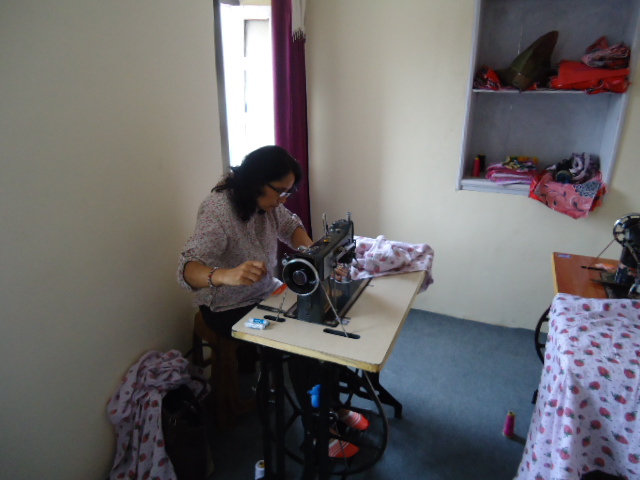
Sister Adhikari is great with a treadle sewing machine. Almost all of the sewing machines are treadle and operated by pumping a pedal with your feet.

Ukpati, RS president sewing.

 Delivering the blankets to the hospital. We had a very nice ceremony.
Lear handing a bag of blankets to doctors. The doctor on the right is a good friend of ours, Dr. Simmi. She is conducting a study correlating survival of premature infants with the use of the breathing equipment we donated to the hospital. She is a remarkable physician and an fine young woman.

Rukmina handing a bag to hospital personnel. Rukmina is the Primary President in our branch and our most valuable helper. We love her and respect her more than I can say.

Tuesday, July 5, 2016

Living in Tents

On April 25, 2015 Nepal suffered a devastating earthquake. Many thousands died and many more thousands were left with out shelter. Thousands of homes were destroyed. Thousands of families had to move from their homes into temporary shelter. This picture and the one below were taken on April 26, 2016 a year after the earthquake.  These pictures show part of a tent city located in Kathmandu. It is very large consisting of about 6 to 10 US city blocks. These families have been living in these temporary huts for over a year.


Wednesday, June 22, 2016

University of Wyoming in Nepal


Church is on Saturday in Nepal. So one Saturday at church we met Nikki Baldwin who is a professor in the College of Education at the University of Wyoming. She is on the far left of the above picture. Every other year she takes a group of education students and grad students to Nepal. They spend several weeks working in schools. We met Nikki and some of the students for dinner one evening. The above picture is of that the group at dinner. 


During our dinner one of the girls wondered if I knew her father since I was a retired banker and her father is a bank president in Wyoming. To my great surprise I found out that her father is Scott Estep, Scott is the president of Wyoming Community Bank in Riverton. He is a former boss and always a friend of ours. Above is a picture of us with Emma Estep, Scott's daughter. Last time we saw her she was probably in grade school. 

Wednesday, May 25, 2016

Bubba's BBQ Nepali Style

Lear is from Texas and we have spent a lot of time driving through that great state. One of our favorite things to do when driving across Texas is to stop at out-of-the-way barbeque places. These places are often called Joes BBQ, Bubba's BBQ or something like that. Many have been very good. A few have been not so good. On occasion we have gotten sick, probably because of the lack of sanitation. Of course the lack of sanitation often makes these places good.


On our recent trip to southern Nepal we were traveling with Rakesh Hamal. Rakesh is the head of  the National Rehabilitation Society for the Disabled. NRSD is the primary NGO (non-governmental organization) that we partner with in Nepal. It was early afternoon and we were driving between cities. Rakesh asked if we had ever eaten wild chicken. In Nepal they have a breed of wild chicken that inhabit the forests. Although they look much like domesticated chicken they are a separate breed of animal called Red Junglefowl.  We said that we had not partaken of this unique Nepali cuisine. We came to the top of a mountain and there was a group of tin sheds. Each tin shed was a small restaurant with chicken carcasses hanging in front. It was Bubba's BBQ Nepali style.


The chicken was GREAT!! We were careful to drink a soda from the bottle.


This picture shows Lear pretending to cook over the wood oven. The chicken is cooked inside the oven on kabob skewers and spiced with some a secret spice known only to Bubba.  

Wheelchairs For Southern Nepal

One of the worldwide initiatives of Latter-Day Saint Charities is to provide wheelchairs to disabled people around the world. On May 20th through May 23rd we went to the cities of Bharatpur and Butwal located in south central Nepal. This was one of the most heart-warming things that we have done!
This is Bikas. This is his second LDSC wheelchair. This one is a tricycle version. You can make it move by pushing and pulling on the steering wheel. Bikas has actually had this chair for 4 years. It is in mint condition. He uses it each day to travel 4.0 miles each way to and from the hospital where his is employed as a computer technician.


This man was injured in a motorcycle accident and is now a paraplegic. He is still recovering and this is his first wheelchair. He will probably get 2 to 5 years out of it.

This is Rebika. She is shown here with her husband, daughter and son. She is suffering from kidney failure. They have had to relocate from their village to the city of Bharatpur as she needs dialysis twice a week. Her husband is a farmer. He is working as a construction laborer in the city. He makes 500 Nepali Rupees per day (about $5).  We also gave them some crutches so she could get into the toilet.

A view of some of the people gathered for the distribution.

This guy was my favorite recipient. He is Tikka. Tikka is a banana farmer and has been disabled for many years. He has a GREAT attitude. He earns a living from his banana farm and also has a copy/lamination business. He a member of several local committees and was getting ready to travel to eastern Nepal to speak at a program about people with disabilities. He is 38 years old. I asked him if he was married. He said that it was hard for a disabled person to find somebody to marry them. He said that he had married an "older" woman 2 years ago. His wife is 24 years old, well past the age of marriage in rural Nepal.

This 14-year-old blind girl was given a walking cane to help her become more mobile.


The above two pictures are of Sunil. Sunil is 28 years old. The first picture shows him crawling into the conference center in Butwal, where the distribution was held. The second picture shows him in his new tricycle wheelchair. About an hour after the program ended we were driving down the street in Butwal. This was about a mile from the distribution site. Sunil was rapidly wheeling down the street with a BIG smile on his face.

Roofing For Schools


On May 4th we went to Charikot in the Dolokha District to deliver roofing material to 25 schools. All of these schools were damaged or destroyed in the earthquake last year. The roofing material was needed to repair the roofs prior to the monsoon.

This is a picture of various officials along with our NGO representatives. You will note that we are wearing silk scarves. The silk scarves were given to us by each of the 25 schools. A silk scarf is a traditional greeting gift for an honored guest at an activity like this. It is not easy to keep 25 silk scarves around your neck for 2 hours! As a part of the ceremony we are expected to give a speech. In this case Scott gave a short speech.

This is a picture Jivan Karki. He is the principal of Jana Jagriti Primary School in Ghyangsukathokar. He has 60 students and has been conducting classes in temporary facilities for the past year. He is a career educator serving in the public schools for 23 years. His school is in a remote village. He needed to get the roof repaired before it starts to rain and rain and rain.