Tuesday, November 22, 2016

Ancient City of Bhaktapur

We visited the ancient city of Bhaktapur. One of the first sights we walked by was a Buddhist temple. As is the case on many Buddhist temples (called Stupa)  this one had the All Seeing Eyes of Buddha.

In front of the doorway to many of the homes in Bhaktapur is a sun symbol.

Wood and stone carvings are everywhere in this ancient city. This pic shows a support beam sticking out from an exterior wall. The end of the beam has been carved into an animal head.

An very old well. No longer in use. Polyethylene pipe is more sanitary but not as picturesque.  

This beautiful stone carving was on a minor temple.
 
This metal sculpture was on the same temple. Note the 8 arms each holding a different symbol.

We were talking with our guide about peacocks in one of the city squares. He said that he knew a window with a great peacock carving. He took us back through some narrow side streets and this is what we saw. I don't think the picture does this amazing work or art justice.
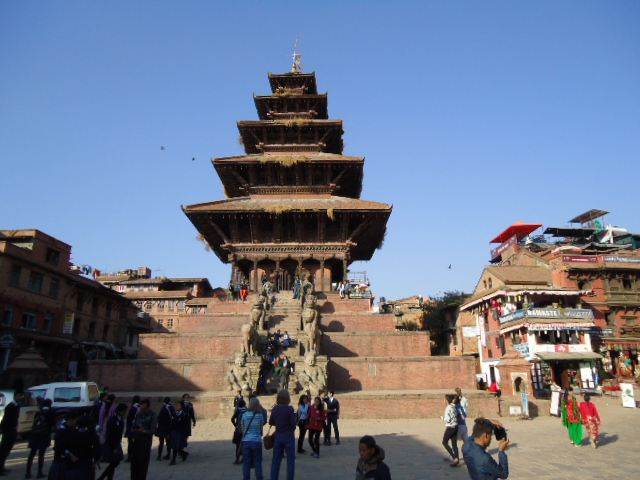

The above 2 pictures are of the Nyatapola Temple which presides over the Taumadhi Square. Dating back to 1702 AD, the colossal five-storied edifice is the country’s tallest pagoda temple.

One of the most beautiful and examples of the ancient Nepali (Newari) architecture, the Golden Gate of Bhaktapur Durbar Square is a masterpiece not only of Nepal but of the world. This door  is decorated with mysterious monsters and other mythical creatures and is of great archaeological, historical and religious importance. It was built by the King, Ranjit Malla in 1753

The lion statues dated to 1696.

                               The next four pictures are of a swimming pool sized royal bath.
The royal bath is surrounded by carvings and statues of Naga (cobra). These are deities that take the form of a snake.  


The bath was filled from a golden spout. This was made in 1678.


In the middle of the pool a Naga rises up in the middle of the pool. If you come to Nepal, Bhaktapur is a must stop. We enjoyed our afternoon here a lot.


Friday, November 4, 2016

A bug, Dashain Festival, a Nepali wheelbarrow, an agressive squirrel and Tehar.

A neat looking bug. There are lots of neat looking bugs in Nepal. And giant spiders and wasps that give you hives and swell your body parts when they sting.

Our landlord's children with their Dashain tikas on their foreheads.

We got a Dashain blessing and tika from the grandmother seated in front of us. This is a Dashain custom in Nepal.

You don't see wheelbarrows in Nepal. They use baskets. When labor is cheap machines are scarce.  

A view from our apartment looking out across the neighborhood. Yes it is very crowded.

This is a squirrel. They look a little like a chipmunk but are much larger. This guy was begging food at a restaurant where we were having lunch. He liked spaghetti.   

The lunch bunch at the Garden of Dreams where we had lunch and met the aggressive squirrel.

Hosting a lunch for young single adults after church.

Lear is standing underneath a poinsettia tree. Yes that is a tree-sized poinsettia bush. They grow them big in Nepal

During the Tehar festival there is a custom of drawing a design on the floor of your home or store to welcome the goddess Laxmi. She is the goddess of wealth.

During Tehar homes and businesses are decorated with flower garlands.

This is a picture of a mother and daughter making a flower garland for their home.


These two dogs got tikas on their foreheads for the second day of the Tehar celebration. That is Kukur Tehar (Dog Tehar).

The street was lined with shops selling garlands and Tehar decorations.

Our landlord's wife and daughter starting to make a Laxmi decoration out of colored powders.

The dogs were very interested.

Our landlord's shrine which is in the garden of our building. Note the garland and also note that there are small pots on the floor. Each pot is a small oil lamp.

The finished product.


We were invited to the Phuel home for a Tehar lunch and celebration. Scott got a Nepali cowboy hat. This is called a topi.

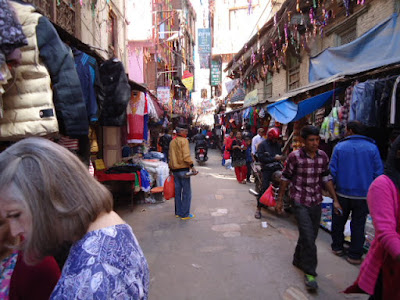
We went to Ason Bazar to buy some bags for a neo-natal training that we are sponsoring. This bazar is a narrow street lined with shops. Bazars like this one are all over Asia and the Middle East. They have been in existence in many places for thousands of years. If it were not for the motorcycle and the cell phone this could be the year 1016 instead of 2016.

This is the bag shop and the bag ladies.

Thursday, October 13, 2016

Nepali Office Depot, Italians, Big Taxi, Heroes and A Bug

Office Depot: We are preparing for a neonatal team visit in November. This is the Nepali version of Office Depot where we buy stationery and folders for the program. In Nepal similar types of stores group together on the same street or in a part of a bazaar. This store is located in an office products mini bazaar.


Italians: We attended a neonatal program. We were surprised to find that it was sponsored by an Italian INGO. We had dinner with the Italian representative after the program. His accent and mannerisms  reminded us of our son in law. We miss you Gabrielle.

Big Taxi: We went to Bharatpur to inspect the wheelchair warehouse. Sugam (shown below) told us that we needed to take some wheelchair cushions to a spinal cord injury center across town. We asked how we were going to transport 4 medium size boxes that far. He said it was no problem and that he would get a big taxi. As you can see we managed to fit the boxes and three passengers into a "big" taxi. Pictured here are Lear and the taxi driver. It was not easy stuffing all of us along with our boxes in this golf cart sized taxi but it worked.

Heroes: Here is a picture of us at our distribution of the cushions at the spinal cord injury center. Standing beside us is Sugam. He helps run NRSD, the NGO (non-governmental organization) that coordinates wheelchair distribution for Latter-day Saint Charities in Nepal. Sugam lost his forward, but not peripheral, vision in a vehicle accident. He decided to dedicate his life to helping others with their disabilities. He manages the center where LDSC has provided computers and programs that teach the blind and disabled to use computer programs and the internet. He also helps with the wheelchair program. Seated in the wheelchair is Samieer Thakuri.  He was an engineering student five years ago when he was hurt in a vehicle accident which left him a paraplegic.  Unable to continue on the career path he had selected, he enrolled at the Nepal Polytechnic Institute to become a medical lab technician.  He has one year left. Samieer lives 13 kilometers south of Bharatpur with his father, mother, younger brother and sister, sister-in-law and cousin.  For the last five years, he has also worked as a peer counselor to the other patients at the spinal injury center.  What a great role model he is.  He told us, “I don’t think of myself as disabled.  The accident gave me a chance to experience two lives in one life.  It helped me develop my self-confidence.”  Both of these fine men are heroes. In the USA many hero-worship the popular politician, the famous actress the billionaire. If only they could appreciate these real heroes.


A Bug: We were going into our apartment and noticed a small bug on the door step. It looked like a cross between a bumblebee and a butterfly. We have seen florescent dragon flies, exotic birds and other creatures that look like they come from a science fiction movie They are in  Nepal.

Wednesday, September 28, 2016


Every 6 months we have the great opportunity to present certificates of completion to graduates from the classes on sewing, knitting and computer for the blind. In the picture above is Shradha Shrestha. She is a graduate of the Sewing Class for Disabled Women; she is completely deaf.  She is from Ason in Kathmandu and lives with her mother and two younger sisters.  Like many of the other students, she learned about the class from a friend.  She has already started a job sewing in a local shop.  Her favorite item of clothing to make is the kurta, a long, colorful top worn over pants or leggings. She is one of those happy people that smiles all the time and uplifts others spirits.


This is Rakesh Thakura, 21, is from Sindhuli in the Tarai (southern) region of Nepal.  He completed his “plus two” education (grades 11 and 12) in Sindhuli, then came to Kathmandu to further his education.  He has just completed the JAWS class, which teaches blind and partially-sighted students how to use a computer.  He will now be able to pursue a bachelor’s degree in education.  He wants to be a teacher.


It was a beautiful day and we decided to walk back to our apartment from a meeting. Right along the side walk was a banana plant. The word for banana in Nepali is Kayrraw. As we said in an earlier post the bananas here are better than what you get in the USA. These are tree-sized plants and you can see the bunch of baby bananas. These were growing in somebody's back yard.


He was a rat, he was dead and he was on the sidewalk. We have seen a few of these carcasses during our on-foot journeys around Kathmandu.


This is a picture of two men on the rooftop next to our apartment. You have heard the term "beat the stuffing out" of something or somebody. Well that is exactly what these men are doing. They are beating a mattress. Actually they took the stuffing out of the mattress first then beat and fluffed the stuffing. Then they put the stuffing back in the mattress and gave it another sound beating. The freshly beaten mattress was then taken back downstairs and re-installed on a bed. We are sure that the mattress was much softer and sufficiently chastened.

Tuesday, August 23, 2016

Flowers, Hair Cuts and Visiting Friends

This flower is in our courtyard. It is a Bird of Paradise flower and we think it is fairly rare. So many beautiful flowers grow here that sometimes it is easy to overlook them.

This pink bell-shaped flower is a Dogray Pul. Pul means flower. The plant is actually the size of a small tree. In Wyoming or Colorado this would  be a potted plant at best. I took this picture looking up at the flowers from the street leading in to our apartments.  

This is a Hibiscus tree. Again this is taken looking up at a small tree on the street.  

One of the things that is much better in Nepal is barbers. A Nepali barber never uses an electric hair trimmer. They only use scissors. The hair cuts are superb. They are the best Scott has ever had. If you let the barber, he will also give you a massage after the haircut. The cost is about $1. Yes, folks, that is not a misprint, it is one hundred pennies.  

This is a picture of the barbershop. The little girl was waiting for her father to get a haircut. As you can see she had a lot a personality.  

This is the finished product.

A few weeks ago we participated in the baptism of Richa. Her parents invited us to lunch. They live in Bhaktapur which is a city very near Kathmandu. The two places are sort of like Denver and Castle Rock, only closer together. Richa is very pretty and very bright. Her parents are both very well- educated and everybody in the home speaks English. Actually many Nepali speak English. Unlike the USA, the schools here stress foreign languages, especially English.

Another picture. Nepali seldom smile when having their picture taken.


This is a picture of the neighborhood around Richa's parents' house. The green, lawn-looking areas are actually rice fields. This is a suburb of Kathmandu on the edge of the Kathmandu Valley. The population of the entire Kathmandu Valley exceeds 2 million people. It has about 220 square miles and is the most populated area in Nepal. Bhaktapur is actually the historic capital. The valley has 7 world heritage sites. Climate-wise it is one of the best places in South Asia to live.

This last picture is of a Relief Society activity that we attended. The Relief Society is the LDS Church women's organization. It is one of the oldest, continuously-functioning women's organizations in the world. Next to Lear in this picture, wearing pink, is Ellen Dietrich. Ellen is a German lady who has dedicated her life to the unwanted children of Kathmandu. For a number of social, religious and economic reasons, Nepal has a lot of orphans that need help. There are a lot of orphanages in Kathmandu. Many do an excellent job. Some of them do not. If you make a donation to a charity in a place like Nepal you need to investigate before writing a check.  Ellen's orphanage is the very best. Her charity is called Haus Der Hoffnung (House of Hope). We have visited the orphanage and know several children that are benefitting from living there. Ellen is a Mother Teresa- like person. She has dedicated her life to helping the most vulnerable and most easily-exploited. Because of her work, numerous lives have been made better and Nepal is a better place.